Virtual reality training in companies: what works and what fails
VR does not solve a training problem, it solves an application problem. Here is where it produces a measurable effect, and where it burns budget for nothing.
Read the article
The cost of a new starter is not measured in training hours. It is measured in hours taken from the existing team, and that line is rarely calculated.

The cost of frontline onboarding rarely sits in the training budget line. It sits in the time the existing team spends supporting the new starter, and in the drop in output at that station during the period.
On an operational station, supporting a new starter typically occupies an experienced employee for several days, part time but continuously. That person slows down, gets interrupted, and their own execution quality drops during the period.
On top of that come start-up errors: wasted product, rework, unhappy customers, minor incidents. Those costs are real but rarely attributed to onboarding, and therefore rarely optimised.
In most frontline organisations, onboarding rests on unstructured mentoring. The new starter follows whichever colleague is available, not necessarily the most rigorous or the best placed to teach.
Three effects follow. The standard passed on is the mentor’s, not the company’s. Onboarding quality varies sharply from site to site. And the existing team experiences each arrival as a burden, which does not help the welcome.
The most effective route is to shift part of the learning ahead of the station. Not more theory, but practical rehearsal.
A new starter who has already been through five critical situations of their future station arrives with bearings. They know where things are, they have already made the classic mistakes in a consequence-free context, and they ask better questions from day one.
The point is not to remove mentoring. It is to make sure the mentor spends their time on what genuinely needs their presence.
Four indicators show whether an onboarding scheme actually works.
That last indicator is often the most revealing. A poor onboarding experience weighs heavily in early departures, and a departure during probation wipes out the entire onboarding investment.
Identify the five situations a new starter inevitably meets in their first two weeks and that generate the most errors. Handle those through practical rehearsal before the station. Keep mentoring for everything else.
Then measure time to autonomy across two comparable cohorts, one with the scheme and one without. That is the only argument that survives a budget review, and it can be built in a quarter.
We run a full 360° scenario in twenty minutes, matched to your activity.
Request a demo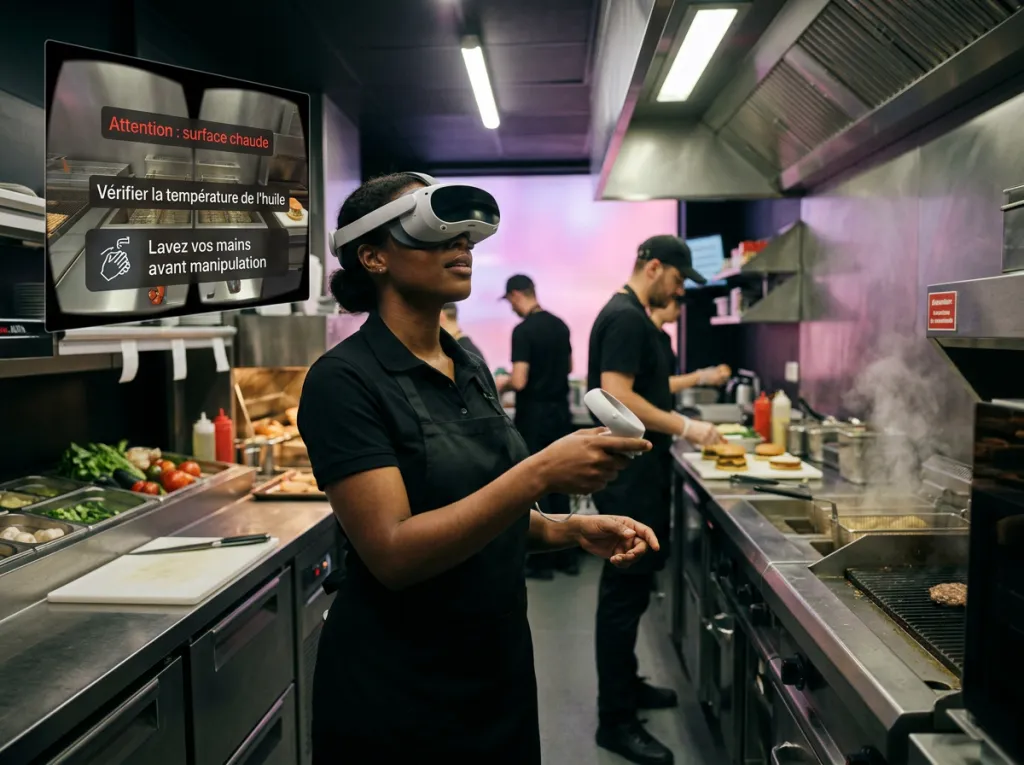
VR does not solve a training problem, it solves an application problem. Here is where it produces a measurable effect, and where it burns budget for nothing.
Read the article
Non-conformities found during inspections rarely reflect missing knowledge. They reflect gestures that give way during the rush.
Read the article